
Del Rio City Directory Shelf
The confirmed local shelf is useful precisely because its gaps are known. The Texas State Library and Archives Commission directory list identifies Del Rio volumes for 1951–52, 1967–68, 1983, 1986–87, and 1989–93. It does not identify a publisher for every volume. Calling each book a Polk directory would add a fact the catalog has not confirmed.
Use the collection as a set of dated snapshots. A listing may show a resident name, address, phone, and spouse. Some volumes add occupation, employer, owner or renter marks, and widow notations. Those extra fields depend on the individual volume, so the printed page and its key matter as much as a search result. For Del Rio family research, a gap is a reason to change sources, not to fill in a household from memory.
| Collection | Years | Where held | Access |
|---|---|---|---|
| TSLAC Del Rio directories | 1951–52; 1967–68; 1983; 1986–87; 1989–93 | TSLAC Reference Reading Room and catalog | Onsite reading-room use |
| UNT City Directories | Texas collection; Del Rio items require an item search | UNT Portal | Public browse or search when digitized |
| UT Texas Directories | Broad late-19th-century to present collection | UT Dolph Briscoe collection | Catalog and item access vary |
| Library of Congress Sanborn maps | 1930–1948, 22 sheets | LOC digital map collection | Free map images, not name entries |
Note: Missing Del Rio years are gaps in the documented holdings list, not proof that no directory was printed or survives elsewhere.
Del Rio Directory Years Without Guesswork
The year pattern is uneven. The early pair is 1951–52, followed by 1967 and 1968, then a jump to 1983. The later run includes 1986, 1987, and 1989 through 1993. That makes a careful search different from a continuous annual timeline. Between 1952 and 1967, or 1968 and 1983, a person may have moved, changed a surname, appeared under initials, or simply fallen in an unconfirmed year.
Write down the volume year and page for every hit. Search both sides of a long gap, then test the address and name against a released census schedule, recorded land document, newspaper notice, or probate record. Do not move a current name backward just because an address matches. Del Rio’s city directory run is evidence for the publication year shown on the page.
| First documented local year | 1951–52 |
|---|---|
| Middle documented years | 1967–68 and 1983 |
| Later documented run | 1986–87 and 1989–93 |
| Publisher and format | Not confirmed for each Del Rio volume |
Finding Del Rio City Directory Volumes
TSLAC says its Del Rio print and microform directories are available in the Austin Reference Reading Room. Staff do not search or transcribe the books by phone or email, so an onsite visit or a researcher who can inspect the volume is the direct route. The TSLAC city-directory guide also points to the UNT Portal, the University of Texas collection, library database access, and WorldCat as discovery routes.
For a local contact, the Val Verde County Library is at 300 Spring Street, with a branch at 315 E Chapoy and a published phone number of 830-774-7595. Its official page confirms library service, but it does not list exact directory, obituary, microfilm, yearbook, or subscription-database holdings. Ask for those titles and years rather than assuming a local shelf exists. A Del Rio inquiry is most useful when it names the year, title, and kind of access needed.
Catalog access and page access are separate questions. A catalog record can identify a useful title even when the volume is onsite, a digitized item may have image or rights limits, and a library database may require local access. For any result, retain the collection name, item title, year, page, and whether the evidence came from a catalog description, index entry, or page image. This distinction keeps a search result from becoming a claimed holding.
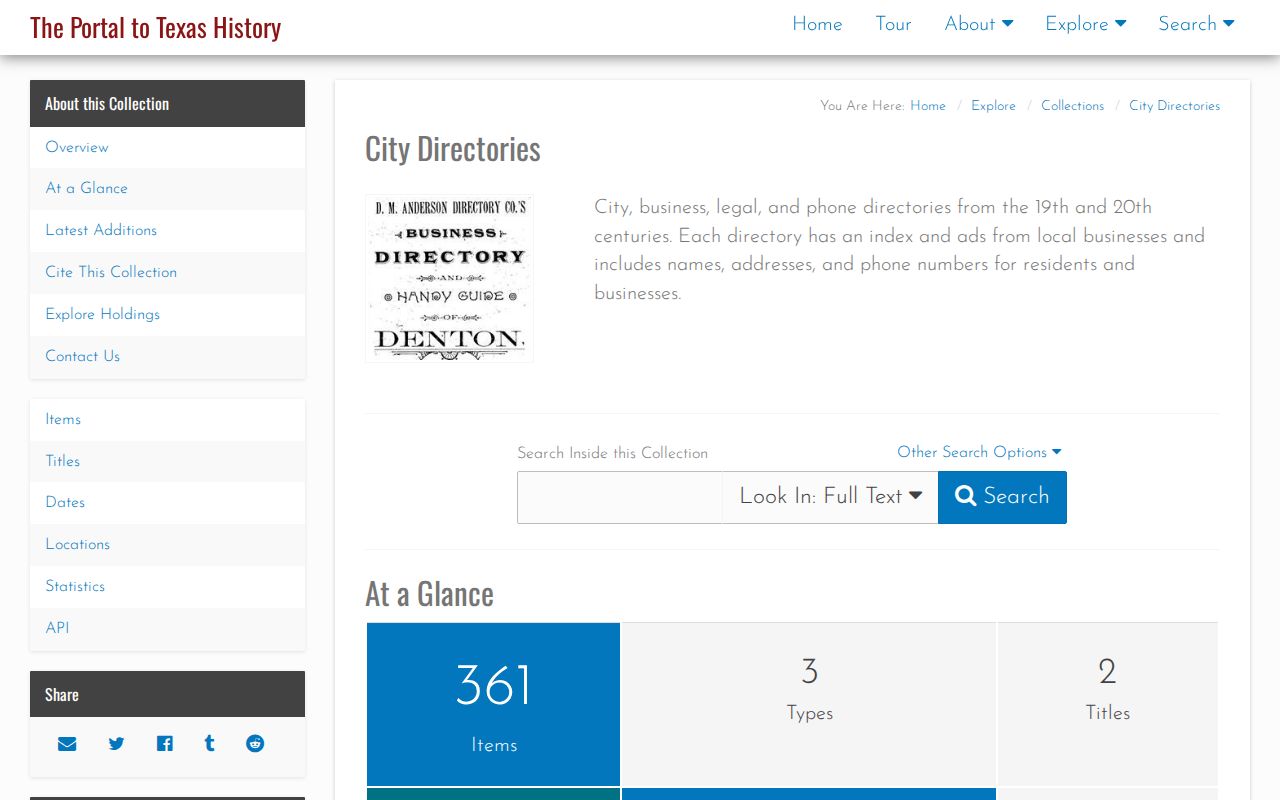
The UNT City Directories collection is the digitized route shown in the image below. A collection search can uncover a digitized item, but it does not promise that every Del Rio volume is online. Record the item title, year, page, and image URL when a result is found.
The UNT City Directories collection provides a digital discovery route for Del Rio directory research.
How a Del Rio City Directory Reads
No inspected official source exposed a Del Rio directory page that can be quoted as a local sample. The safe approach is to inventory what the opened volume actually prints. TSLAC describes common fields, but conventions vary between books. Keep initials, punctuation, directional street letters, apartment marks, and spelling exactly as printed before trying expanded forms or normalized addresses.
A directory entry is not a census household. It can omit children, renters, unrelated occupants, or a household that was not included. An address can also be a business or mailing line. Treat it as a dated directory clue, then confirm the role and time period in another appropriate record. A Del Rio entry should retain its printed role instead of being recast as a present address.
| Printed name | Copy initials, surname form, and any cross-reference exactly |
|---|---|
| Household notation | Record spouse or household text only if the volume prints it |
| Address and phone | Preserve the street line, exchange, and apartment marks as printed |
| Work or tenure clue | Occupation, employer, owner/renter symbol, or widow notation may appear by volume |
| Source detail | Keep year, page, entry type, and the abbreviation key used |
- Criss-cross directory
- A directory arranged by address or street rather than only by name. No verified public Del Rio criss-cross run was located.
- Householder index
- An index organized around the named household entry, which may not include every person at the address.
- Abbreviation key
- The volume’s own explanation of initials and marks. Read it before expanding a symbol or label.
Del Rio Directory Names and Variants
Search the exact form first, then broaden carefully. Del Rio research benefits from trying accents or diacritics, compound surnames, paternal and maternal surname order, married and maiden forms, initials, and names used by trustees or estates. OCR adds another reason to vary the search. It can misread surnames, initials, and old telephone exchanges.
The city also began as San Felipe del Rio. An 1883 post-office change shortened that name to Del Rio to avoid confusion. Early newspaper, directory, and postal searching should test both forms. Preserve the source’s original place label alongside a modern label instead of silently replacing one with the other. Del Rio search notes work best when they show which place-name form produced each hit.
Note: A missed name can reflect a spelling, an index error, a different directory type, or an unconfirmed gap in the Del Rio run.
Del Rio Maps Around Directory Years
The Library of Congress Del Rio Sanborn set supplies 22 sheets dated from 1930 through 1948. It can show a street name, building footprint, use, or vacant space. It cannot name a resident. Pair a map with the nearest directory, deed, or newspaper source when testing whether a claimed address refers to the same structure.
This is a useful records-history checkpoint. Val Verde County was organized in 1885, while the documented directory holdings begin much later in 1951–52. The historic courthouse and jail complex at 400 Pecan Street has different completion references in local sources, including an 1887/1888 courthouse date and a 1915 expansion. Preserve that difference in a research note rather than picking a date without its source.
| Period | Del Rio historical source | Best use |
|---|---|---|
| 1885 onward | Val Verde County records | Keep the county-boundary date in mind for early events |
| 1930–1948 | Sanborn maps | Date street and building context |
| 1951–1993, with gaps | Documented city directories | Locate dated name and address clues |
| 1982 onward | County online land-record index | Follow recorded instruments online |
Linking Del Rio Directories and Census
Use an address or exact name to work outward. The 72-year federal census release rule means later schedules are not a shortcut for recent years, but a released schedule can help place a household near a confirmed directory volume. The best pairing is the nearest available directory on either side of the census year, with every date labeled by its own source.
- Open the directory’s alphabetic index and copy the name, address, phone, and every printed notation.
- Check the street index when the volume has one, then compare nearby documented Del Rio years.
- Pair the result with the nearest released census schedule, respecting its release date and address context.
- Use a deed, map, newspaper notice, or probate file to test a move, death, or ownership change.
- Keep a not-found log for years, spellings, and places already checked.
The household layer belongs to the source that names it. A directory owner/renter mark is historical notation, not present-day status. The address-focused record chain is handled by the Del Rio Street Directory when the question moves from an old volume to a modern parcel.
When a Del Rio Directory Trail Ends
A disappearance may mean a move, death, changed name, skipped volume, different entry type, or indexing problem. Search nearby years, spouse names, prior addresses, and a business name. Then look for notices, advertisements, legal notices, and obituaries in the UNT Texas Digital Newspaper Program, while recognizing that Del Rio title-level coverage has not been confirmed on the collection landing page.
The Val Verde County Historical Commission documents markers, cemeteries, research projects, and historic buildings, but no searchable interment or obituary index was found in the reviewed sources. The FamilySearch Val Verde catalog lists filmed death certificates for 1932–1971, marriage records for 1885–1955, a birth-card index for 1903–1932, and birth records for 1906–1929. A catalog lead may not be name indexed or available as an open image, so record the film or item number and its access limit.
For a hard-to-place household, preserve a short record log: the name form searched, street line as printed, volume year, page, result, and access route. That keeps a blank search from becoming an invented conclusion. It also leaves a useful trail when a later visit to the Austin reading room, a library database, or a catalog film supplies the missing connection.