
Del Rio Previous Residents by Era
Different sources answer different parts of an address history. The current Val Verde CAD record can provide the parcel bridge. Del Rio recorded land instruments show parties and legal descriptions. Directories and released census schedules add dated household clues, while Sanborn sheets explain the street and building setting. None is a complete list of who lived at an address, so label the role each record actually supports. For Del Rio address research, that role label is the safeguard against turning a name into an occupancy claim.
Start with the time period you need. Online land records are best for the later deed trail. Older Del Rio household research may begin with a directory or map, then return to the County Clerk when a legal description is known. The table keeps the confirmed coverage separate from sources whose local range has not been verified. Del Rio sources are strongest when their dates are kept beside the result.
| Source | Years it covers | Where held | What it shows |
|---|---|---|---|
| Sanborn fire-insurance maps | 1930–1948 | Library of Congress | Street, building footprint, use clues, and map labels |
| Del Rio city directories | 1951–52; 1967–68; 1983; 1986–87; 1989–93 | TSLAC list and collections to verify | Name, address, phone, and volume-dependent household clues |
| Official land-record index | 1982 to present stated online | Val Verde County Clerk portals | Grantor, grantee, recording date, document type, and image pointer |
| CAD or tax card | Current public service; older 2013–19 packet examples | Val Verde CAD and county packets | Owner, mailing and situs fields, legal description, values, and exemptions |
| Federal census | Released schedules under the 72-year rule | Census and archival access routes | Historical household, age, relationship, and address context |
| FamilySearch vital groups | Selected 1903–1971 groups | Val Verde catalog and films | Event and relationship clues where access permits |
Note: No confirmed public Del Rio criss-cross run or permit index was found, so neither should be treated as an available address roster.
Start Del Rio Previous Residents at the Parcel
Use the Val Verde Central Appraisal District public property service to capture the current situs, property or account number, Geo ID, legal description, and owner field. Expected search routes include owner name, situs address, and property, account, or Geo ID, though exact live field labels and wildcard behavior were not exposed in the research capture. Keep the tax year and source date with each result. In Del Rio, the Geo ID and legal description help carry a parcel across changing address formats.
Do not merge the physical situs with the tax mailing address. A mailing line may be a post office box, a representative, a trust, or a different city. It is a tax-record field, not proof that an owner lived there. A homestead exemption can be consistent with owner occupancy, but it does not establish a current resident. A Del Rio situs is the map location, while the mailing field remains a separate public tax-record label.
- Parcel or account ID
- An appraisal identifier used to connect a mapped property record to tax information.
- Geo ID
- A local parcel or map identifier. Examples in Val Verde records use four-digit hyphen blocks.
- Legal description
- The recorded land description, such as a subdivision, block, lot, tract, or metes-and-bounds description. It is often more stable than a street line.
Del Rio’s 1982 Deed Index Threshold
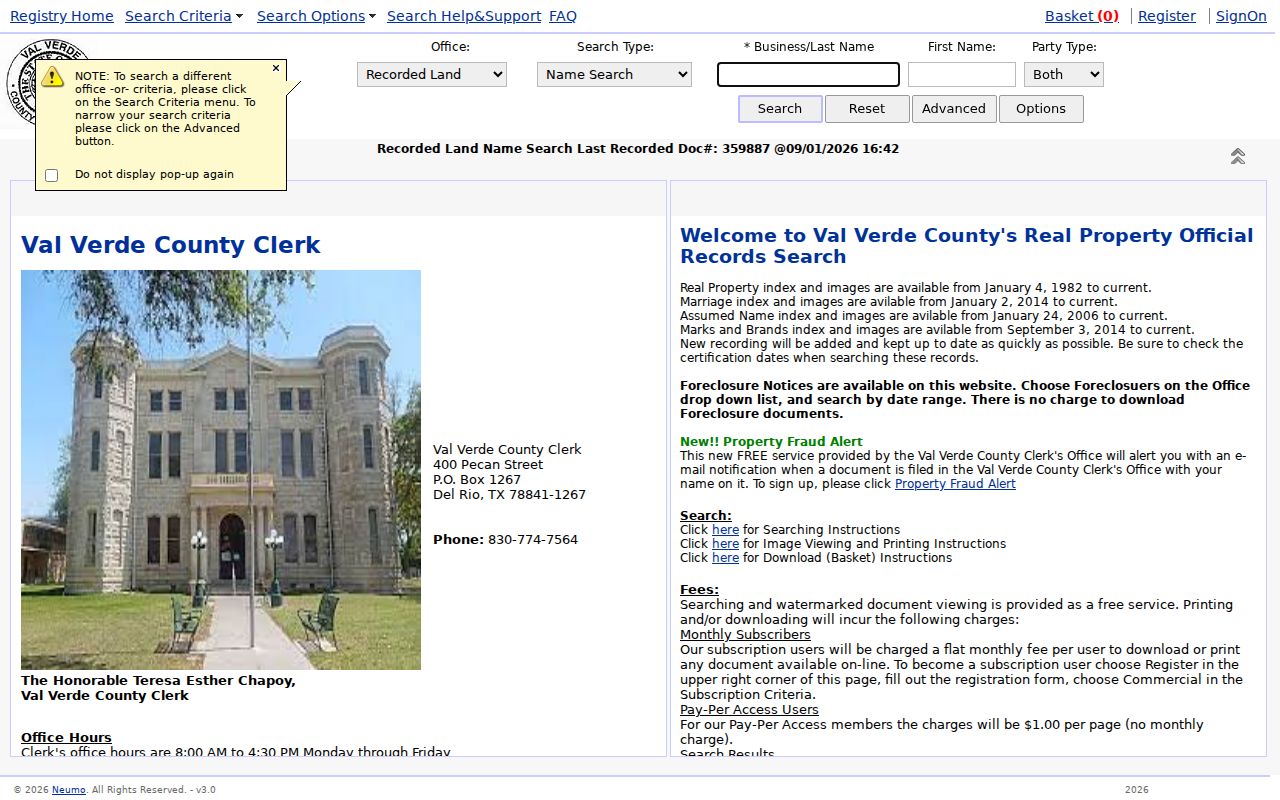
The County Clerk states that online land-record coverage runs from 1982 to the present. The Val Verde County Real Property Official Records Search supports free searching and watermarked viewing. Printing or downloading can involve charges or an account. Check the portal’s certification date, and request a certified copy from the clerk when legal proof is required. For Del Rio chains, that online date is a research boundary rather than an ownership starting point.
Earlier deed books and the exact pre-1982 cutoff are not confirmed in the reviewed material. When the online chain ends, contact the Val Verde County Clerk in Del Rio with the legal description, both party names, approximate year, and record type. Ask whether the next record is in a book or microfilm, and whether plain copies, certified copies, or an onsite reference are available. The Texas Public Information Act, Texas Government Code chapter 552, provides a written-request route for existing government records, with prompt production or notice when more than 10 business days are needed. It does not require an office to make a new combined history.
The Val Verde official-records search is the starting point for the online portion of a Del Rio previous-residents deed trail.
Trace Del Rio Past Owners Through Val Verde Deeds
A chain of title follows recorded ownership transfers, not necessarily occupants. In the County Clerk index, start with the current owner as grantee. Use a broad date range around the apparent acquisition, then record the instrument number, recording date, grantor, grantee, document type, volume or page, and legal description. Compare that legal description to the CAD record before taking another step. A Del Rio legal description is more reliable than a street line when an old instrument uses a subdivision or tract.
- Capture the current CAD owner, legal description, Geo ID, and situs.
- Search the current owner as grantee in the official-records index, using name search and party type Both before narrow filters.
- Inspect the acquisition instrument and copy its grantor, legal description, recording date, and instrument or volume reference.
- Search that grantor as grantee to find the prior acquisition, then repeat backward with spouses, estates, trustees, and spelling variants.
- At the online limit, ask the County Clerk for a targeted book or microfilm route and record the access result.
- Grantor
- The party conveying an interest in an instrument.
- Grantee
- The party receiving an interest in an instrument.
- Chain of title
- The sequence of recorded instruments used to trace legal interests in a parcel.
Del Rio Deed Branches Are Not Moves
Not every instrument is an ordinary sale. The Val Verde portal’s document vocabulary includes warranty, special, general, grant, gift, and trustee deeds, plus deeds of trust, releases, liens, easements, plats, corrections, affidavits of heirship, probate, and distribution records. It has duplicate and abbreviated document labels, so a broad name and date search with all document types is safer than guessing one label. Del Rio deed research should preserve the exact portal label even when a fuller document name seems obvious.
One instrument may convey a partial interest. A spouse may appear in one record but not another. An estate can act through an executor or trustee. Keep a separate list for trustees, lenders, businesses, estates, attorneys, and public bodies. They may explain the chain without being previous residents or past households at the property. A Del Rio chain can branch through an estate or trustee without showing a household move.
For a Del Rio sale that does not fit the pattern, search related probate, heirship, distribution, correction, release, easement, and plat records. Follow a cited instrument number when one appears. The stop rule is practical: pause when the legal description no longer matches, the next party cannot be located, or the clerk confirms that the next material is book-only.
Del Rio Address History on Sanborn Sheets
The Library of Congress Del Rio Sanborn record covers 1930 through 1948 in 22 sheets. Use it to learn whether a parcel held a dwelling, business, institutional building, outbuilding, or vacant space during that period. The sheets provide building and street context, not a resident-name index. Del Rio Sanborn sheets can therefore test a structure date without assigning a person to it.
That distinction helps avoid a common error. A building can remain on the lot while the business, institution, or household changes. Pair the map with the nearest directory or newspaper for people, and with a deed for a legal transfer. The Del Rio historic civic landscape can also help orient old research: Val Verde County was organized in 1885, and the courthouse and jail complex has documented 1880s and 1915 milestones with differing courthouse-completion references that should remain attributed.
Note: A Sanborn sheet can date a structure’s context, but it cannot prove who lived or worked at that address.
Pair Del Rio Directories With Census
For past residents, use the documented directory years as household clues rather than a continuous address sequence. The known Del Rio runs are 1951–52, 1967–68, 1983, 1986–87, and 1989–93. Match a released census schedule to the nearest volume, then bridge long gaps with newspapers, deed changes, probate, or school and yearbook material only where a source actually supports the connection. A Del Rio directory result is dated evidence, not a substitute for an unreleased census schedule.
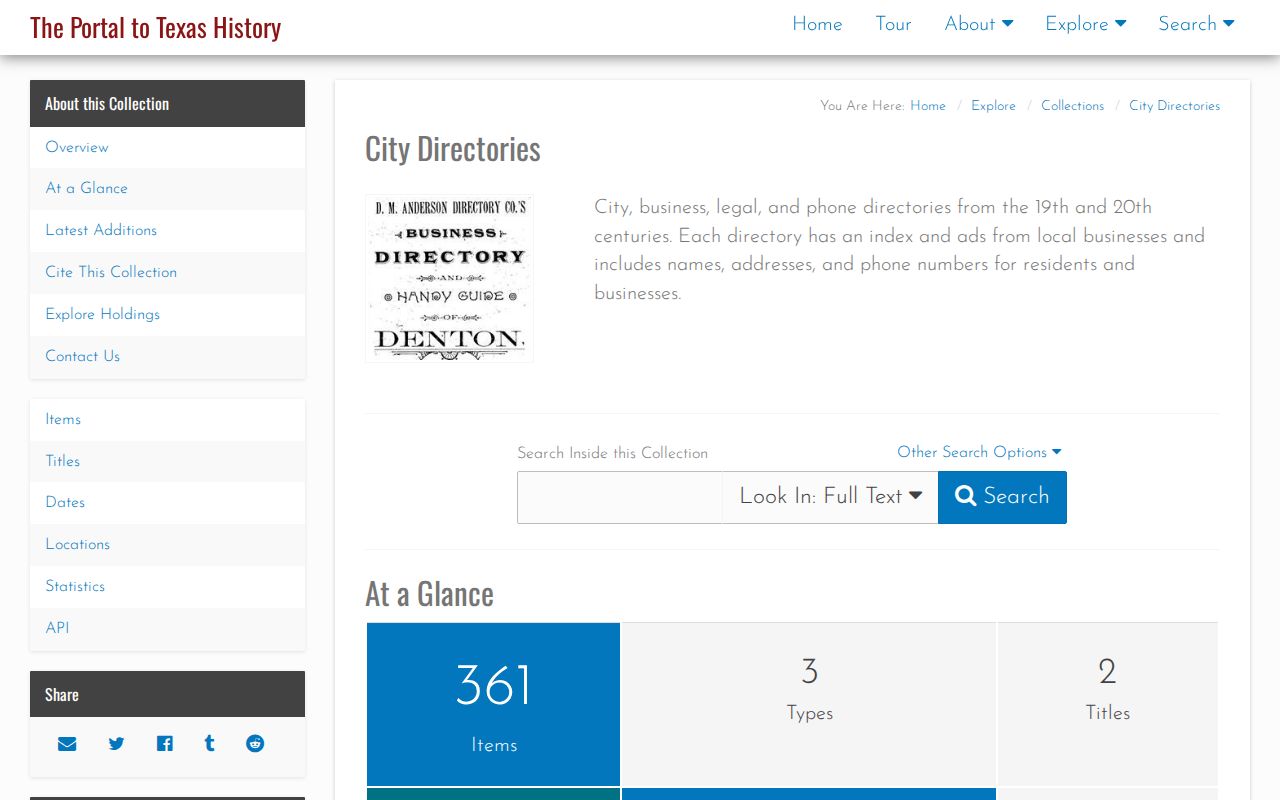
The UNT City Directories collection is a digitized discovery route. It may expose a Texas city, business, legal, or phone directory, but Del Rio item availability still needs verification. Record the volume, page, and image URL. The confirmed shelves and how to read their entries are described in the Del Rio City Directory collection reference. Del Rio item availability must be established volume by volume.
UNT’s digitized City Directories collection can help identify a volume before a Del Rio address is compared with a released census.
- Copy a directory entry exactly, including initials, spouse notation, address, and phone exchange.
- Check adjacent confirmed directory years before jumping to a census decade.
- Use the nearest released census schedule for a dated household comparison.
- Test a disappearance with a deed, newspaper notice, obituary, or probate record.
Del Rio Previous Residents Need Address Proof
No official Del Rio street-renumbering or renaming year was located. A changed suffix, directional, rural-route line, subdivision name, or house number is therefore an unresolved mapping issue, not a reason to merge two addresses. Use old plats, city ordinances, Sanborn sheets, and the legal description to test continuity. Keep both the original printed line and any later normalized version in the research notes. A Del Rio address match needs that supporting bridge before two records are joined.
Local record language can be more durable than a street line. County examples include HUNTER BLOCK C LOT 1, VEGA VERDE BLOCK H LOT 1, and Castle Canyon Estates Block 2 Lot 12. Geo IDs and block-lot descriptions can carry a trail across a changed address format. A parcel split, condominium unit, rural-route conversion, or tract consolidation may still break that continuity, so inspect each instrument rather than relying on a map label.
Del Rio Previous Residents and Trail Endpoints
When a directory occupant disappears, look for a dated endpoint. Search newspaper death, memorial, legal-notice, and business pages, then test probate, an affidavit of heirship, a distribution deed, or executor filing. A surviving spouse or heir may explain a transfer. An obituary address can be historical, a funeral-home address, or a family-contact address, so it should not be treated as a later residence. In Del Rio, an endpoint source should be saved with its date and the address role it actually reports.
The FamilySearch Val Verde catalog lists filmed death certificates for 1932–1971, marriage records for 1885–1955, a birth-card index for 1903–1932, and birth records for 1906–1929. Those are film and catalog leads, not a promise of an online name index. Access restrictions can apply. The County Library and Historical Commission are documented local contact routes, but no official house-history service, public obituary index, or cemetery database was found.
Personal research limit. Use a Del Rio address trail for family or house history, and keep protected data and living people’s privacy in view. A deed party, map label, or old directory entry is not a claim about a current occupant.